Self-employed, interim or permanent: what’s the difference and what does it mean for you?
Striive now powered by
You hear these terms everywhere: self-employed, interim, permanent employment. But what do they actually mean? More importantly, which option is right for you, or for the professional you’re looking for? We’ve outlined the key differences, so you can make an informed choice today.
What’s the difference between self-employed, interim and permanent employment?
In short, the difference comes down to three things: the type of contract, the level of freedom and the security that comes with it.
Permanent employment means you are employed by one organisation. You have an employment contract, build up a pension, receive pay when you are off sick and know exactly what you earn each month.
Interim describes the nature of the assignment, not your legal employment status. You take on a temporary role, often at management or specialist level. This might be during a reorganisation, a period of increased workload or while a permanent vacancy is being filled. There are different ways to arrange this: as a self-employed professional working on your own account and risk, or as an employee of a staffing or contracting agency working for clients.
Self-employed means you work independently, without employees. You work on your own account and risk, invoice your clients directly and decide how much, where and for whom you work. There is no employer and no fixed salary, but you have a high degree of freedom.
One important point to remember: self-employed versus employed and interim versus permanent are two different dimensions. The first relates to your legal and tax status. The second describes the duration and nature of your role. You can therefore be self-employed and work on an interim assignment, or work as an interim professional while being employed.
Self-employed or employed: the key differences
Most of the questions we receive are about the difference between being self-employed and being employed. That makes sense: these are the two ends of the spectrum.
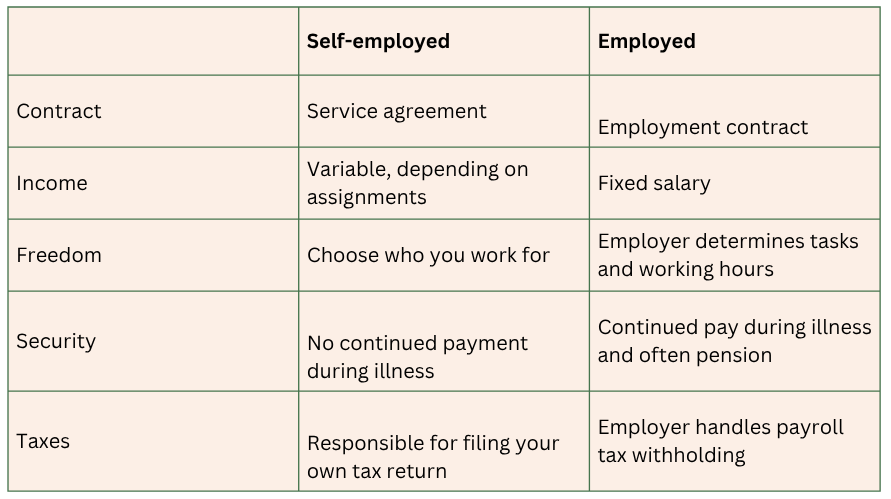
As a self-employed professional, you are responsible for your own administration, insurance and pension. In return, you decide which clients you work with and what rate suits the assignment. As an employee, you give up some of that freedom in exchange for greater financial security.

What’s the difference between interim and self-employed?
Interim and self-employed are often used interchangeably, but they are not synonyms. They answer different questions.
Interim tells you something about the assignment: it is temporary and often involves a more senior role. Examples include interim management, interim project leadership or a specialist role covering for someone during absence or a period of growth. The length of the assignment determines how long you work on an interim basis.
Self-employed tells you about your legal status: you are an independent business owner, registered with the Dutch Chamber of Commerce (KvK), and work on your own account and risk.
This means you can take on an interim assignment in two ways:
- As a self-employed professional. You invoice your client directly and arrange your own tax, insurance and pension. You also carry the risk of having no income when the assignment ends, while retaining a high degree of freedom.
- As an employee of a staffing or contracting agency. The agency places you with clients and continues to pay your salary between assignments. You have the security of an employer, combined with the variety of interim work.
In short: every self-employed professional working temporarily for a client is effectively working on an interim basis. But not every interim professional is self-employed. You can also take on a temporary role as an employee.
Self-employed or permanent: which option suits you?
There is no right or wrong answer. A few questions can help you decide.
- Do you value security, structure and a fixed salary? Then permanent employment is likely to suit you. You don’t have to find new assignments yourself and you know where you stand financially.
- Do you prefer freedom, flexibility and the opportunity to set your own rate? Then self-employment gives you more room to choose. You build your own professional profile, choose your clients and shape your work around your life.
- Do you want variety without the administrative responsibilities of being self-employed? Then interim work as an employee of a staffing or contracting agency offers an attractive middle ground. You get the variety of different assignments, with more security than you would have as a self-employed professional.
Interim or permanent: what about clients?
The choice also matters to organisations. A permanent employee builds up knowledge within the organisation and contributes with a long-term perspective. An interim professional or self-employed specialist often brings expertise that you don’t need on a permanent basis and can get started quickly when needed.
At Striive, we match professionals and clients every day. Whether you’re looking for a self-employed professional for a temporary project or an interim specialist for a larger challenge, we focus on what fits the assignment, the organisation and the professional.
Looking for your next step?
Whether you’re thinking about becoming self-employed, want to work on interim assignments or are looking for the right professional for your organisation, Striive helps you find the right match. Explore the possibilities and find your next assignment today.