The rise of mid-level and senior professionals and the declining demand for juniors
The Dutch labor market is undergoing rapid and fundamental changes. Whereas in recent years a shortage of talent led to strong demand for professionals at all levels, a new pattern is now emerging: a clear shift from demand to supply, with mid-level and senior professionals benefiting most and juniors losing ground.
This trend is clearly visible in the Talent Monitor Q1 by HeadFirst Group and Intelligence Group (2026) and has an impact on both employers and independent professionals.
1. Demand is shifting: fewer juniors, more experienced professionals
The summary of the Talent Monitor clearly states:
“The increasing demand for mid-level and senior professionals is driving up average rates, while the declining demand for juniors is linked to both a built-up labor reserve and the impact of AI developments.”
Why is the demand for juniors declining?
- Accumulated labor reserve
In recent years, many juniors have been hired due to shortages. This group now forms a buffer: organizations have no immediate need for even more starters. - AI mainly replaces junior tasks
According to the monitor, junior roles are the first to be eliminated in reorganizations, including in support functions such as customer service, administration, and HR support. - Lower risk acceptance when hiring
Due to economic uncertainty and rising costs (such as collective bargaining agreement increases), organizations are opting for immediate employability—something that mid-level and senior professionals offer better.
2. The rise of mid-level and senior professionals
The demand for experienced professionals continues to rise for various reasons:
Experience is direct value
Organizations have less room for training programs. Experienced professionals can contribute immediately to complex projects, change processes, and specialisms where pressure is increasing.
Seniors are retained – juniors are lost
The monitor shows that in AI-sensitive positions, it is mainly senior professionals who remain in place and that temporary gaps are filled with experienced staff.
Scarce senior roles drive rates up
Although overall rate growth in 2026 will be limited (+1.0%), differences between professional groups will remain significant. In sectors such as healthcare, construction, and engineering, rates are actually rising.
3. Market mechanism shifts from scarcity to ‘buyer's market’
A crucial background development from the Talent Monitor:
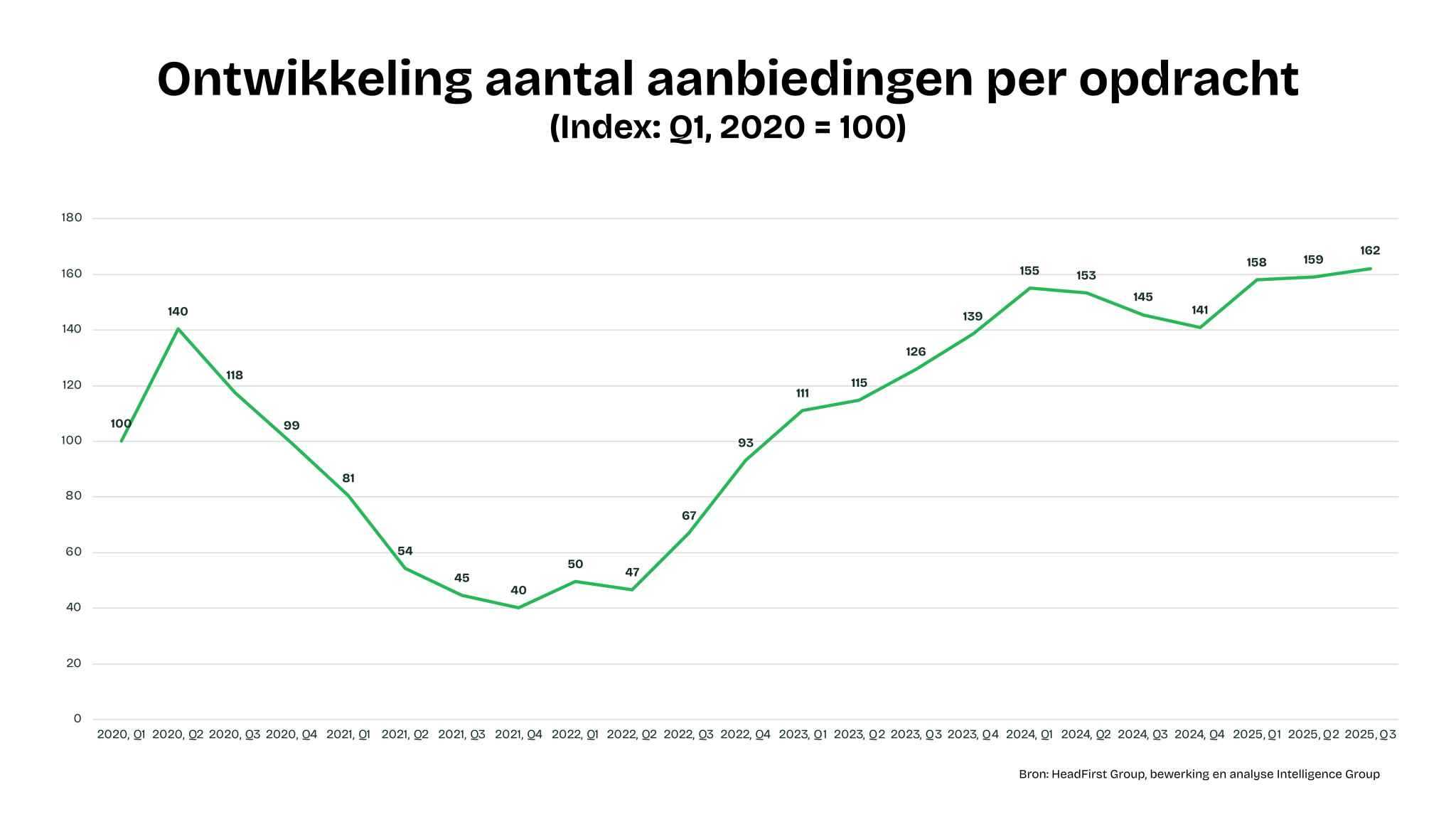
- The number of offers per assignment is four times higher than in 2021 (record level).
- The number of assignments without offers has virtually disappeared.
- Self-employed professionals are being approached less often by clients.
This means more competition, particularly noticeable among juniors and generalists.
4. Impact on rates: gradual slowdown in growth, but differences are increasing
The average rate increase in 2026 is exceptionally low: +1.0%. Nevertheless, differences between professional groups remain large. The rising demand for mid-level/senior talent is actually putting upward pressure on rates in these groups.